Independent writing on tax-smart planning, mortgage strategy, and retirement building. For Canadian professionals who want the whole picture, not just a piece of it.
Trump's Tariff Threat Is the Rate-Cut Risk No One's Pricing In
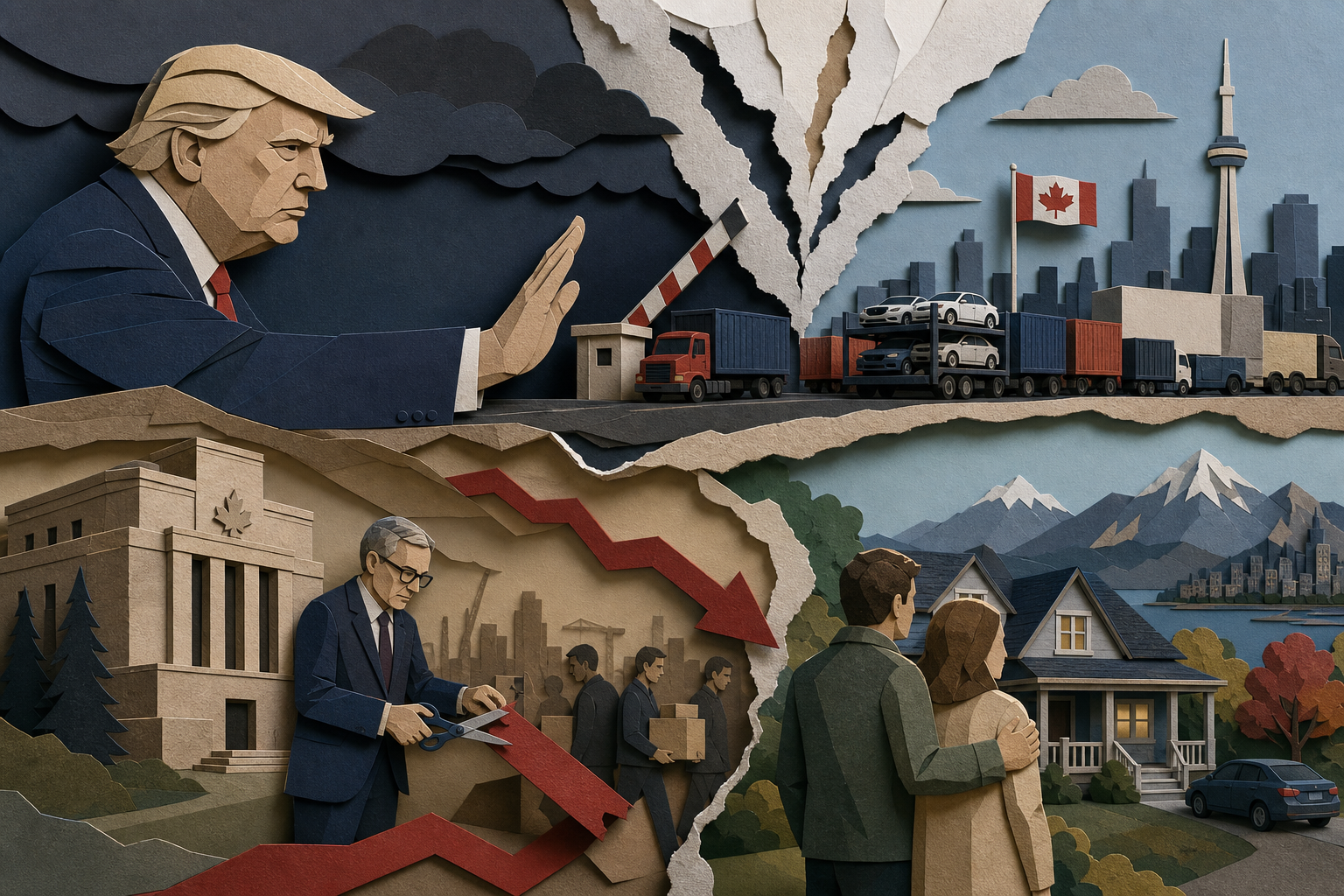
The Bank of Canada's forward guidance for 2026 reads like a done deal: rates on hold until late in the year, inflation stable around target, the economy tracking close to potential. BMO Economics called it "firmly on hold" as recently as last month. That view assumes trade rules stay intact. They won't.
The 2026 USMCA review lands in October, and the Trump administration has spent the past six months floating a 10% universal tariff on imports as both negotiating leverage and policy intent. Markets are treating this as noise. It isn't. If those tariffs materialize, even at half the threatened scale, the Bank of Canada will be cutting rates by year-end, not holding them.
The deflationary channel nobody's talking about
Here's what makes this counterintuitive: tariffs are inflationary for the country imposing them and deflationary for the country absorbing them. U.S. consumers pay more for Canadian lumber, steel, and energy. Fine. But Canadian exporters lose volume, shed jobs, and pull back capital spending. Roughly 75% of Canadian exports head south of the border. A 10% tariff isn't a rounding error, it's a demand shock large enough to stall GDP growth.
When export revenue collapses, domestic spending follows. Layoffs in manufacturing ripple into retail. Business investment freezes. The stuff the Bank of Canada actually tracks, core inflation, wage growth, capacity utilization, all soften. And when inflation threatens to undershoot the 2% target, the central bank has one move: cut rates.
The irony is that while the Federal Reserve keeps rates elevated to fight domestic inflation caused by those same tariffs, the Bank of Canada would be forced to ease into a slowing economy. That's the monetary policy divergence trade nobody's pricing in yet. The loonie weakens. Mortgage rates drop. And suddenly the housing market that was supposed to stay frozen gets a jolt of liquidity it wasn't expecting.
Why the "hold" narrative breaks
BMO's original forecast relied on stable trade flows and predictable policy. The USMCA review torpedoes both. Under the sunset clause, all three countries must confirm in writing by October 2026 that they want the agreement to continue. The U.S. administration has every structural incentive to extract concessions by threatening not to sign. That threat alone is enough to chill Canadian business investment.
The data backs this up. During the 2018-2019 steel and aluminum tariff disputes, Canadian business confidence dropped sharply even though the tariffs themselves were narrow. Firms don't wait for the policy to land, they delay capital expenditures the moment uncertainty spikes. That delay shows up in GDP within two quarters.
And the "bark versus bite" counterargument, that Trump often threatens more than he delivers, misses the mechanism. It's not the tariff itself that forces the Bank of Canada's hand. It's the slowdown caused by firms and households bracing for it. Uncertainty is deflationary. The central bank responds to the data it sees, not the policy it hopes will happen.
What this means for rates
If tariffs hit in the fall, the sequence is predictable. Export orders soften through Q4. Unemployment ticks up in early 2027. Inflation undershoots. The Bank of Canada cuts by 25 basis points in January, another 25 in March. By mid-2027, the policy rate sits a full point lower than where it started the year, and the market that spent all of 2026 pricing in "higher for longer" scrambles to reprice everything at once.
The mortgage market gets the clearest signal. Variable-rate holders who've been bleeding on renewals suddenly find relief. Fixed rates drop faster than anyone modeled. And the real estate sector, which was supposed to stay suppressed by elevated borrowing costs, finds itself with cheaper credit exactly when supply constraints haven't eased.
Trade wars don't announce themselves cleanly. By the time the tariff is official, the damage is done.



The Bank of Canada's forward guidance for 2026 reads like a done deal: rates on hold until late in the year, inflation stable around target, the economy tracking close to potential. BMO Economics called it "firmly on hold" as recently as last month. That view assumes trade rules stay intact. They won't.
The 2026 USMCA review lands in October, and the Trump administration has spent the past six months floating a 10% universal tariff on imports as both negotiating leverage and policy intent. Markets are treating this as noise. It isn't. If those tariffs materialize, even at half the threatened scale, the Bank of Canada will be cutting rates by year-end, not holding them.
The deflationary channel nobody's talking about
Here's what makes this counterintuitive: tariffs are inflationary for the country imposing them and deflationary for the country absorbing them. U.S. consumers pay more for Canadian lumber, steel, and energy. Fine. But Canadian exporters lose volume, shed jobs, and pull back capital spending. Roughly 75% of Canadian exports head south of the border. A 10% tariff isn't a rounding error, it's a demand shock large enough to stall GDP growth.
When export revenue collapses, domestic spending follows. Layoffs in manufacturing ripple into retail. Business investment freezes. The stuff the Bank of Canada actually tracks, core inflation, wage growth, capacity utilization, all soften. And when inflation threatens to undershoot the 2% target, the central bank has one move: cut rates.
The irony is that while the Federal Reserve keeps rates elevated to fight domestic inflation caused by those same tariffs, the Bank of Canada would be forced to ease into a slowing economy. That's the monetary policy divergence trade nobody's pricing in yet. The loonie weakens. Mortgage rates drop. And suddenly the housing market that was supposed to stay frozen gets a jolt of liquidity it wasn't expecting.
Why the "hold" narrative breaks
BMO's original forecast relied on stable trade flows and predictable policy. The USMCA review torpedoes both. Under the sunset clause, all three countries must confirm in writing by October 2026 that they want the agreement to continue. The U.S. administration has every structural incentive to extract concessions by threatening not to sign. That threat alone is enough to chill Canadian business investment.
The data backs this up. During the 2018-2019 steel and aluminum tariff disputes, Canadian business confidence dropped sharply even though the tariffs themselves were narrow. Firms don't wait for the policy to land, they delay capital expenditures the moment uncertainty spikes. That delay shows up in GDP within two quarters.
And the "bark versus bite" counterargument, that Trump often threatens more than he delivers, misses the mechanism. It's not the tariff itself that forces the Bank of Canada's hand. It's the slowdown caused by firms and households bracing for it. Uncertainty is deflationary. The central bank responds to the data it sees, not the policy it hopes will happen.
What this means for rates
If tariffs hit in the fall, the sequence is predictable. Export orders soften through Q4. Unemployment ticks up in early 2027. Inflation undershoots. The Bank of Canada cuts by 25 basis points in January, another 25 in March. By mid-2027, the policy rate sits a full point lower than where it started the year, and the market that spent all of 2026 pricing in "higher for longer" scrambles to reprice everything at once.
The mortgage market gets the clearest signal. Variable-rate holders who've been bleeding on renewals suddenly find relief. Fixed rates drop faster than anyone modeled. And the real estate sector, which was supposed to stay suppressed by elevated borrowing costs, finds itself with cheaper credit exactly when supply constraints haven't eased.
Trade wars don't announce themselves cleanly. By the time the tariff is official, the damage is done.
Read Next
Why DLC paid $58.5 million for Filogix and what brokers actually need to worry about
MCAN's 19% earnings jump proves impaired loans aren't the threat everyone thinks they are
The Personal Letter to Sellers Still Works, Just Not for the Reason You Think
25 States Sue Over Trump Tariffs, Arguing the President Cannot Tax Without Congress