Independent writing on tax-smart planning, mortgage strategy, and retirement building. For Canadian professionals who want the whole picture, not just a piece of it.
Canadian Shoppers Are Buying More Than Just Gas Again
Statistics Canada's preliminary June 2026 figures show a 0.4% increase in retail trade, which sounds modest until you notice what drove it. For the first time in over a year, the number isn't being pushed around by what happened at the pump.
Through late 2025 and into early 2026, retail headlines told a misleading story. Gas prices would spike, retail sales would jump. Prices would drop, the numbers would flatten. The pattern made it impossible to tell whether Canadians were actually buying more or just paying more for the same tank of fuel. June breaks that rhythm.
Why this month is different from the last twelve
The 0.4% gain includes gas, but it doesn't lean on it. Preliminary estimates suggest that even with gasoline and motor vehicles stripped out, two categories that swing hard and distort the aggregate, core retail sales are showing modest but real growth. That hasn't been true for most of the past year.
What's filling the gap is household goods, apparel, and the categories that people defer when mortgage payments reset or uncertainty spikes. A 47-year-old in Burlington who locked in at 1.79% in 2021 and renewed this spring at 5.2% has been living with higher payments for months now. June's data suggests that cohort, and there are hundreds of thousands of them, has stopped deferring and started buying again, selectively.
This isn't exuberance. It's exhaustion with frugality. The Canadian consumer spent a year and a half in aversion mode, cutting discretionary purchases down to near zero in some households. What the June numbers show is a shift from "can't afford to spend" to "can't afford to keep waiting."
The mortgage cliff that didn't collapse the system
Analysts spent 2025 warning about the "mortgage renewal cliff." Borrowers who took out five-year fixed mortgages in the 2020-2021 window were set to renew into an environment where rates had tripled. The prediction was a sharp pullback in spending as debt-servicing costs ate into discretionary budgets.
That pullback happened. Household debt-to-income ratios in Canada remain near 175%, among the highest in the OECD. But the cliff didn't collapse the system, in part because employment held. Stable jobs provided a floor. The retail uptick in June suggests many households have now absorbed the new payment, recalibrated their budgets, and resumed some version of normal spending.
The Bank of Canada's "higher-for-longer" posture is still in effect. Rates haven't dropped. What's changed is that consumers have stopped waiting for them to.
What 0.4% actually measures
A 0.4% nominal increase is not a spending boom. If inflation for the same month runs at 0.3%, real volume growth is 0.1%, a rounding error in any other context. What makes it meaningful is the direction and the breadth. Retail sales are now slightly outpacing monthly CPI increases, which means Canadians are buying marginally more goods, not just paying more for the same basket.
The motor vehicle and parts subsector remains a significant contributor, largely because supply chain lags that constrained inventory through 2023 and 2024 have fully normalized. Dealers have stock again. Buyers who delayed a replacement are moving.
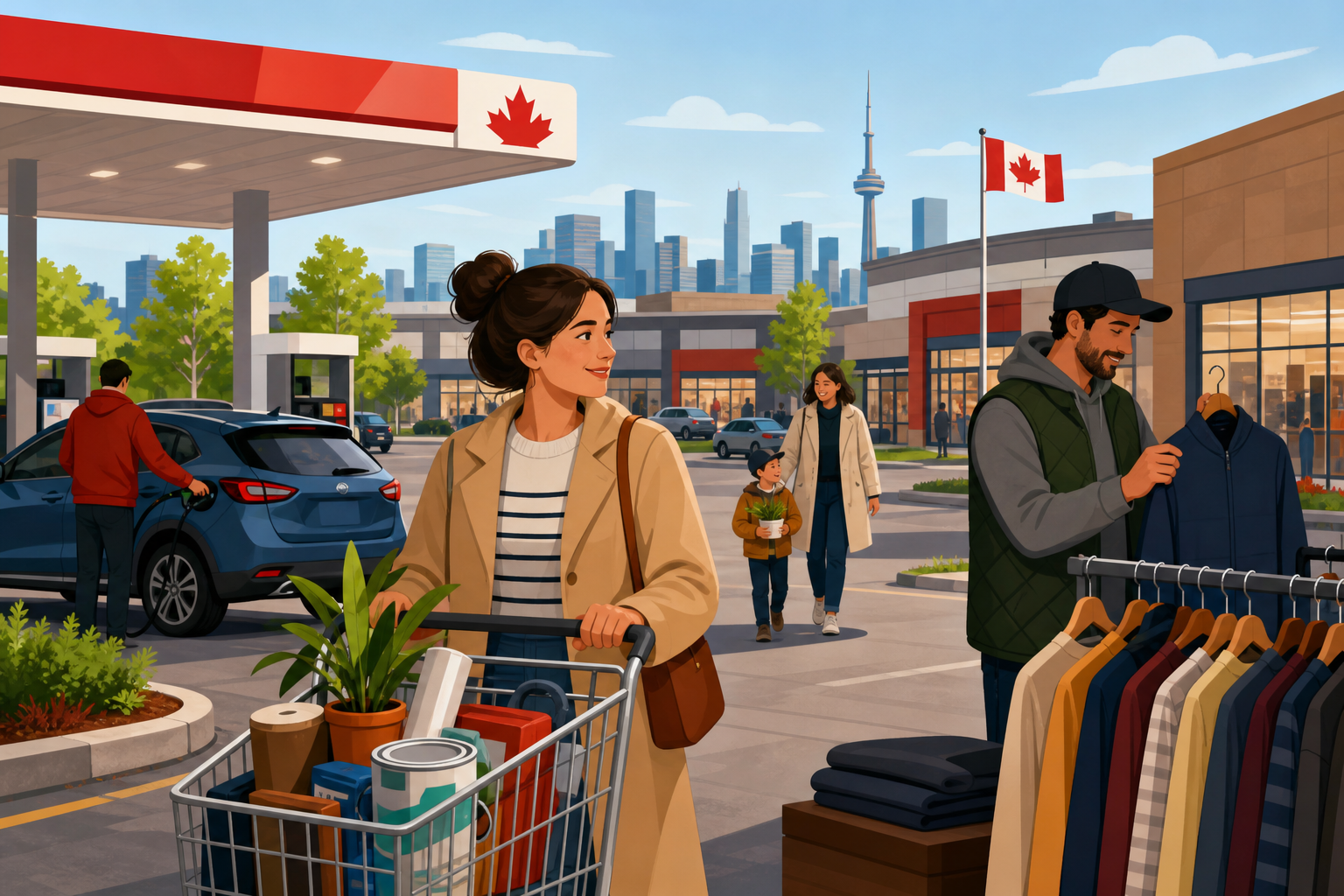
Digital sales continue to hold around 5-6% of total retail trade, a plateau they've occupied since late 2022. Brick-and-mortar foot traffic showed resilience in early summer, particularly in categories like patio furniture, gardening supplies, and seasonal apparel, purchases that signal people are planning for more than survival.
June's 0.4% is not a recovery. It's a decoupling. For the first time in over a year, the retail number is telling you something about what Canadians are doing, not just what they're paying for gas.



Statistics Canada's preliminary June 2026 figures show a 0.4% increase in retail trade, which sounds modest until you notice what drove it. For the first time in over a year, the number isn't being pushed around by what happened at the pump.
Through late 2025 and into early 2026, retail headlines told a misleading story. Gas prices would spike, retail sales would jump. Prices would drop, the numbers would flatten. The pattern made it impossible to tell whether Canadians were actually buying more or just paying more for the same tank of fuel. June breaks that rhythm.
Why this month is different from the last twelve
The 0.4% gain includes gas, but it doesn't lean on it. Preliminary estimates suggest that even with gasoline and motor vehicles stripped out, two categories that swing hard and distort the aggregate, core retail sales are showing modest but real growth. That hasn't been true for most of the past year.
What's filling the gap is household goods, apparel, and the categories that people defer when mortgage payments reset or uncertainty spikes. A 47-year-old in Burlington who locked in at 1.79% in 2021 and renewed this spring at 5.2% has been living with higher payments for months now. June's data suggests that cohort, and there are hundreds of thousands of them, has stopped deferring and started buying again, selectively.
This isn't exuberance. It's exhaustion with frugality. The Canadian consumer spent a year and a half in aversion mode, cutting discretionary purchases down to near zero in some households. What the June numbers show is a shift from "can't afford to spend" to "can't afford to keep waiting."
The mortgage cliff that didn't collapse the system
Analysts spent 2025 warning about the "mortgage renewal cliff." Borrowers who took out five-year fixed mortgages in the 2020-2021 window were set to renew into an environment where rates had tripled. The prediction was a sharp pullback in spending as debt-servicing costs ate into discretionary budgets.
That pullback happened. Household debt-to-income ratios in Canada remain near 175%, among the highest in the OECD. But the cliff didn't collapse the system, in part because employment held. Stable jobs provided a floor. The retail uptick in June suggests many households have now absorbed the new payment, recalibrated their budgets, and resumed some version of normal spending.
The Bank of Canada's "higher-for-longer" posture is still in effect. Rates haven't dropped. What's changed is that consumers have stopped waiting for them to.
What 0.4% actually measures
A 0.4% nominal increase is not a spending boom. If inflation for the same month runs at 0.3%, real volume growth is 0.1%, a rounding error in any other context. What makes it meaningful is the direction and the breadth. Retail sales are now slightly outpacing monthly CPI increases, which means Canadians are buying marginally more goods, not just paying more for the same basket.
The motor vehicle and parts subsector remains a significant contributor, largely because supply chain lags that constrained inventory through 2023 and 2024 have fully normalized. Dealers have stock again. Buyers who delayed a replacement are moving.
Digital sales continue to hold around 5-6% of total retail trade, a plateau they've occupied since late 2022. Brick-and-mortar foot traffic showed resilience in early summer, particularly in categories like patio furniture, gardening supplies, and seasonal apparel, purchases that signal people are planning for more than survival.
June's 0.4% is not a recovery. It's a decoupling. For the first time in over a year, the retail number is telling you something about what Canadians are doing, not just what they're paying for gas.
Read Next
Why DLC paid $58.5 million for Filogix and what brokers actually need to worry about
MCAN's 19% earnings jump proves impaired loans aren't the threat everyone thinks they are
The Personal Letter to Sellers Still Works, Just Not for the Reason You Think
25 States Sue Over Trump Tariffs, Arguing the President Cannot Tax Without Congress